The NGO Bureau chief says about 7,000 NGOs operate in Uganda, though many have closed or downsized due to funding and compliance challenges
Kampala, Uganda | JULIUS BUSINGE | The future of Uganda’s non-governmental organisation sector is increasingly uncertain, as a combination of donor withdrawal, regulatory scrutiny and operational disruptions raises questions about the sustainability of a network that has long played a central role in delivering social services across the country.
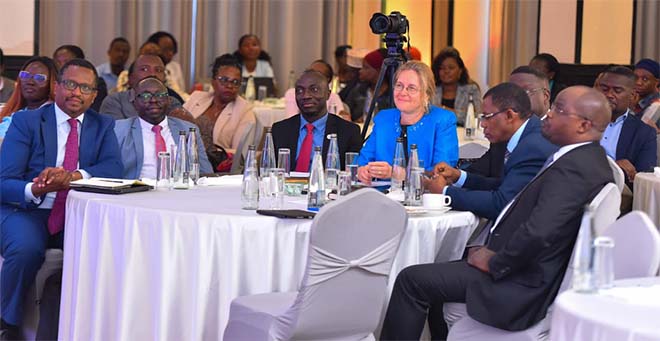
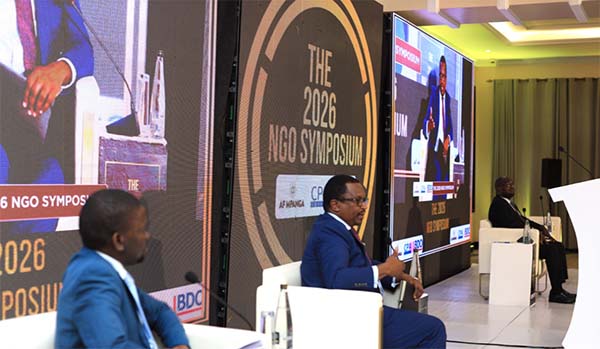
Warnings about the sector’s fragility were delivered at the NGO Symposium 2026 held in Kampala on March 11, where government officials, development partners, accountants and civil society leaders gathered to assess the outlook for a sector that contributes billions of shillings annually to the national economy.
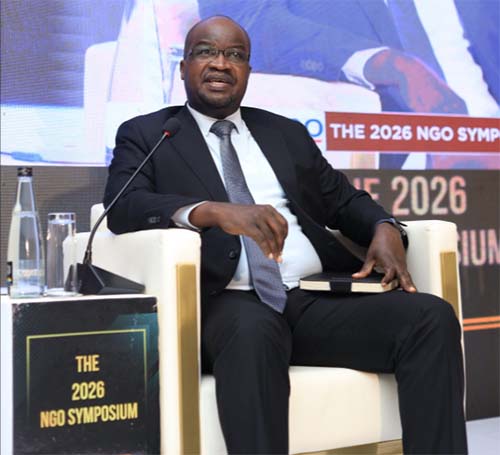
Speaking at the event, Stephen Okello, commissioner of the National NGO Bureau offered a stark assessment of the pressures facing civil society organisations.
“There is a trend — when Democratic Governance Facility (DGF) left, came COVID-19, thereafter, USAID funding was cut. The sector is now desperate, this should worry all of us. We are waiting for the worst,” he said.
His remarks reflect a growing sense that Uganda’s NGO ecosystem, once sustained by strong international donor flows, is entering a period of structural adjustment as funding patterns change and regulatory oversight intensifies.
A sector central to service delivery
Non-governmental organisations have historically played an important role in Uganda’s development landscape, complementing government programmes in areas such as healthcare delivery, education access, poverty alleviation, gender equality and environmental protection.
They also act as intermediaries between communities and policymakers, mobilising resources, advocating for policy reforms and supporting grassroots initiatives through training and capacity-building programmes.
Okello acknowledged the sector’s contribution, noting that NGOs often provide services in communities where government capacity is limited. But he warned that sustainability concerns are mounting, particularly as organisations struggle to maintain compliance with financial and legal standards while facing shrinking budgets.
Without stronger accountability mechanisms and financial transparency, he said, the credibility of the sector risks erosion at a time when donor confidence is already weakening.
Against this backdrop, the symposium also marked the introduction of a new global accounting framework designed specifically for the non-profit sector.
The International Non-Profit Accounting Standard, known as INPAS, is intended to improve financial reporting and governance among non-governmental organisations worldwide.
Developed over six years under the IFR4NPO project by Humentum and the Chartered Institute of Public Finance and Accountancy, the framework was formally launched in October 2025.
Advocates say the system will help NGOs strengthen transparency and demonstrate more clearly how resources are translated into social impact.
Okello described the new framework as an important tool for rebuilding donor trust in an environment where funding is becoming more competitive.
The framework standardises financial reporting while also incorporating narrative reporting, allowing organisations to show how their programmes translate into measurable outcomes.
INPAS Adoption and Engagement Director, Samantha Musoke, said narrative reporting would enable organisations to connect funding with real-world impact more effectively.
Meanwhile, Charles Lutimba, director of Standards at the Institute of Certified Public Accountants of Uganda (ICPAU), argued that a common reporting structure would allow donors to compare financial disclosures across organisations more easily, improving confidence in how funds are managed.
Professional services firms have also highlighted the importance of capacity building during the transition.
Kenneth Mankanga, the managing partner at BDO East Africa, said NGOs would require training and technical support to adapt their financial systems to the new standard.
Contraction in the sector
While the new accounting framework is designed to strengthen governance, the broader environment facing Uganda’s NGO sector remains difficult.
According to data presented at the symposium, roughly 7,000 NGOs are currently operating in Uganda. However, many organisations have scaled back operations or closed altogether in recent years due to funding shortages and regulatory compliance challenges.
The sector is estimated to contribute around Shs4tn ($1.08bn) annually to the economy while employing thousands of workers across project management, community outreach, research and administrative functions.
But this contribution is increasingly threatened by declining donor support. One major blow came with the closure of the Democratic Governance Facility, a multi-donor initiative that had financed governance and civil society programmes in Uganda for years.
The facility’s withdrawal left hundreds of organisations and their staff without funding.
Another shock followed when the United States Agency for International Development scaled back major grants to Uganda. The reduction removed more than $400m in annual funding that had supported programmes in healthcare, education and community development.
Pandemic aftershocks
The COVID-19 pandemic further weakened the financial resilience of NGOs. Lockdowns disrupted project implementation and community outreach activities, forcing organisations to close offices or suspend operations.
Many NGOs also faced steep declines in donor income as global priorities shifted towards emergency response and domestic spending in donor countries.
Sector estimates suggest that some organisations lost up to 85 per cent of their revenue during the pandemic, pushing many into financial distress.
The resulting staff layoffs and project cancellations have had lasting effects on service delivery across rural and urban communities.
Financial pressures have been compounded by growing tensions between civil society organisations and regulators.
In the weeks preceding Uganda’s January 2026 general elections, the National Bureau for Non-Governmental Organisations suspended several prominent organisations.
Among those affected were Chapter Four Uganda and the Human Rights Network for Journalists-Uganda, alongside other civil society groups involved in governance and rights advocacy.
Authorities said the organisations had engaged in activities “prejudicial to the law of Uganda”, a claim that prompted criticism from both domestic civil society groups and international observers.
Some analysts questioned the timing of the suspensions, arguing that they occurred during a politically sensitive period.
Okello defended the Bureau’s actions, saying enforcement measures were taken only after organisations failed to comply with regulatory requirements.
“If the people in organisations know what they are doing and ensure compliance to the law, there would be no problem,” he said.
Critics, however, argue that stricter enforcement and administrative suspensions risk narrowing civic space and discouraging participation in governance debates.
Social and economic consequences
The combined effect of donor withdrawal, regulatory pressures and organisational closures has produced tangible consequences for Uganda’s social services and local economies.
Healthcare programmes funded by international donors have been particularly affected. Clinics providing treatment for HIV/AIDS and tuberculosis through donor-supported programmes have faced closures or service reductions.
According to sector estimates, roughly 1.4 million people rely on antiretroviral therapy supported by programmes previously financed through international donors.
Cuts to funding have also disrupted programmes in maternal health, water and sanitation, agricultural livelihoods and education support.
The economic ripple effects extend beyond the NGOs themselves. Project closures have led to job losses among NGO staff as well as contractors and local suppliers that provide goods and services to development projects.
Transport companies, hotels, conference facilities and printing firms that depend on NGO spending have also experienced declining demand.
At a macroeconomic level, analysts say reduced donor inflows may weaken local consumption and increase unemployment pressures in some regions.
Policy and political backdrop
Uganda’s policy environment has also influenced donor confidence. The passage of the Anti-Homosexuality Act 2023 prompted criticism from several international partners.
Analysts estimate that the legislation could result in economic losses of up to $1.6bn annually through reduced aid flows, foreign investment, tourism and trade.
While the government has defended the law as reflecting national values, the broader diplomatic fallout has complicated relations with some development partners.
Faced with these pressures, sector leaders are exploring ways to stabilise the NGO ecosystem. One proposal involves diversifying funding sources beyond traditional international donors.
Local philanthropy, corporate partnerships, and income-generating activities have been identified as activities that could help organisations reduce reliance on external grants.
Supporters of INPAS argue that improved transparency will help NGOs rebuild credibility with donors and attract new funding streams.
Advocacy for clearer and more predictable regulations is also emerging as a central theme. Civil society groups have called for legal frameworks that protect freedoms of association and expression while maintaining accountability standards.
Partnerships with government agencies are another potential avenue for sustaining service delivery in areas where donor funding has declined.
Sector at a crossroads
Okello also revealed that the government is planning a comprehensive study examining the contribution of NGOs to Uganda’s development.
The “State of NGOs” report will assess economic impact, employment levels and social outcomes linked to the sector.
Its findings will be presented to cabinet and may inform future policies aimed at strengthening the NGO ecosystem.
For many analysts, the sector now faces a decisive moment. Funding reductions, tighter regulation and shifting geopolitical priorities have altered the environment in which NGOs operate.
But the new tools, such as global accounting standards, capacity-building programmes and policy reforms could help organisations adapt. Whether these efforts succeed will depend largely on cooperation between government regulators, civil society groups and international partners.
For now, the outlook remains uncertain. Okello’s warning at the symposium captured the mood of a sector navigating difficult terrain: the pressures are real, but the response will determine whether Uganda’s civil society organisations can reinvent themselves and continue playing a central role in the country’s social and economic development.