Kampala, Uganda | MELINA RAQUEL PLATAS | This was an odd election. On the one hand, the opposition seemed both weaker and more straight-jacketed than any election in decades. On the other hand, the brute force of the state suggested sincere concern about an electoral upset. No one seemed able to confidently predict the end result, and yet when it arrived it felt extremely obvious, even hackneyed. President Museveni: 71% and change. Latest opponent: 25% or thereabouts. Not even close.
Talking to youth in Kampala and surrounds in early January you could be forgiven for thinking President Museveni was on his last legs. These youth – and many others — now believe they were robbed of victory. Not that they were very optimistic about their chances. “Only God can help us,” one told me – explaining that even though 80 percent of the country supported Bobi Wine (Robert Kyagulanyi), he was going to be rigged out, again. Was that figure true? I wondered at the time.
I had the opportunity to leave Kampala, and Buganda, shortly thereafter. I’m not going to claim I did anything like a representative survey. Even if I had conducted one, I wouldn’t have trusted the results. Unfortunately, I suspect many Ugandans – and especially Kyagulanyi supporters – are afraid to reveal their true preferences to a stranger tapping their answers into a tablet. Very little to gain and very much to lose. But what I did see, on a journey of nearly 1500 kilometers, was a country that has, over the past several decades, faded to many shades of yellow.
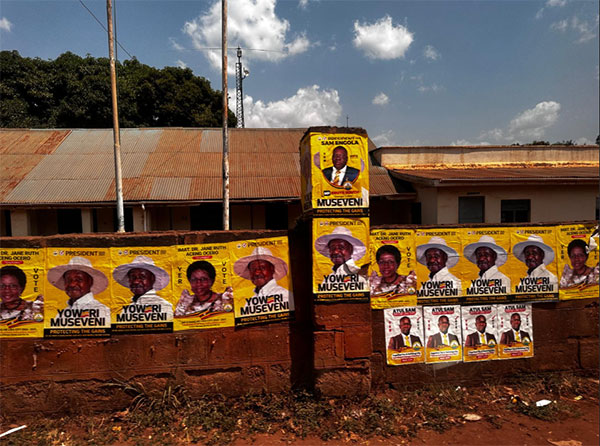
After leaving the city, it took several hours to find a Kyagulanyi poster on the roadside. There were many posters of parliamentary candidates running on the National Unity Platform (NUP) ticket, who had Kyagulani’s photo alongside their own. But a standalone poster of the man himself I did not see until Kigulu, just outside Iganga.
Again, this is odd, even by historical precedent. I have seen Besigye’s posters torn and targeted in elections past, but they were always still stubbornly present. Supporters and party members would valiantly re-paste them after a sweep by who knows who. Clearly, NUP supporters had given up on the Sisyphean task this time around, punished as they were not just with endless repetition but also the threat of kidnap or arrest.
Instead, throughout Buganda and Busoga, I started noticing makeshift wooden poles – some so tall I even wondered how they managed to anchor them – with little flags at the top, blowing in the wind. Motorcycles and minibuses too, often sported red, yellow and black stripes flapping as they sped along. These were the unofficial campaign posters, I knew. A masterstroke by someone in NUP, maybe the only one they had managed. When the government starts placing restrictions on flying its own national flag, you know you are doing something right, and also that things have gone terribly wrong.
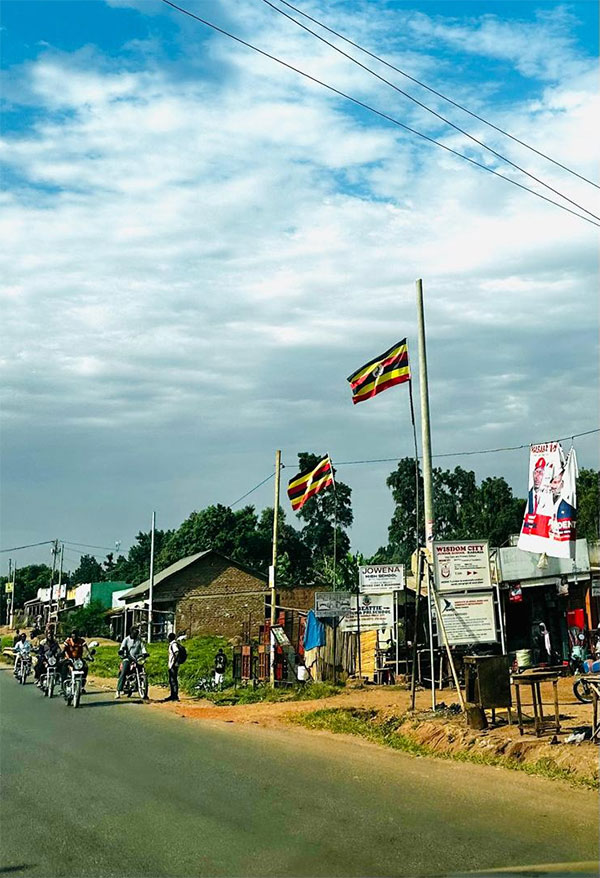
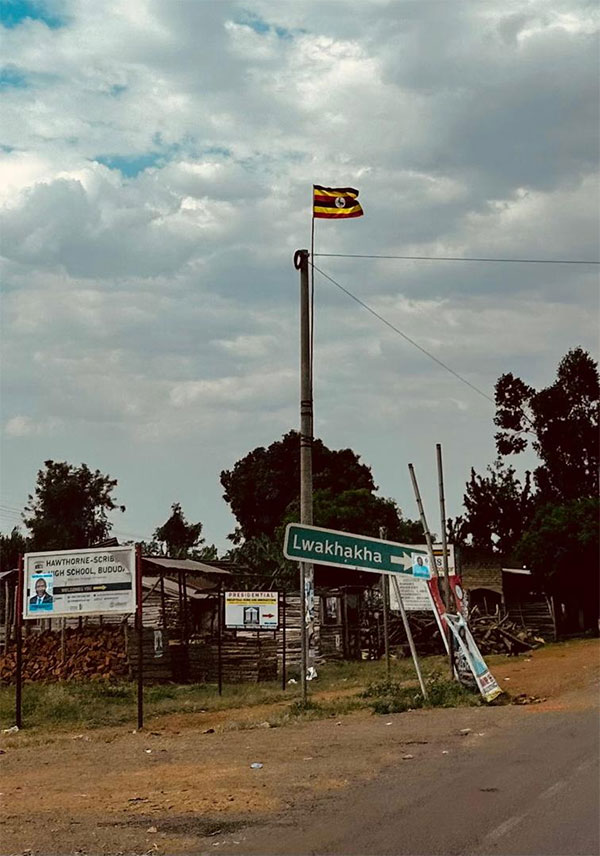
All of this smacked of suppression of true preferences, but also, while the presence and use of the flags were striking, there were not that many, really. And they all but disappeared by the time we reached Bugisu. In most town center roundabouts, whether in Tororo, Gulu, Lira, or Hoima, yellow was the prevailing color, and usually advertising parliamentary candidates. It almost felt as if the presidential contest had already been decided and there was no need to discuss it further.
After the experience of driving through the east, north, west, and center in the days before the election, the vote count — which were harder than usual to follow, everyone having been plunged into cyber darkness — was not very surprising. President Museveni won by a landslide on paper, but this result raises many more questions than it answers.
What happened here? I don’t know. How much of the count was manufactured, how much was a reflection of true preferences, and how much was a function of fear? I don’t know, and no one does, whatever claims they might make. There are no data that will tell us that, least of all the official results.
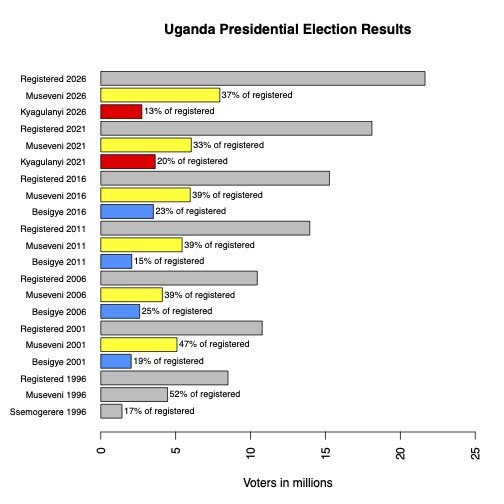
One thing is certain. This 71 percent, which sounds like an overwhelming win, does not represent a broad mandate. Just over a third of the electorate voted for the president in this, his seventh contest since taking power. However, this is not unique to the 2026 election. Since coming to power, President Museveni has only received a majority of the share of registered voters once – in 1996.
This election, in which 37 percent of registered voters showed up to vote for the president (caveats to follow), looks almost identical to 2006, 2011, and 2016, in all of which Museveni received 39 percent of the vote among registered voters. What changed, if anything, was the share of votes for the opposition. This year Museveni’s main opponent received 13 percent of the vote among registered voters, the lowest of any runner up in the past seven elections.
Of course, as in elections past, we know that electoral malpractice took place. The numbers signed off by Byabakama, as was the case with his predecessors, do not represent the actual count of humans who placed a tick next to their preferred candidate. As usual, there were polling stations with 100 percent turnout, perhaps plausible by chance once an election cycle, but a few hundred times over, always in the same set of districts, more than strains credulity.
The outlandish results in the cattle corridor are not very interesting anymore though. Kyagulanyi was never going to be able to get many votes into boxes in Kiruhura, though I would like to talk to the 162 people who supposedly voted for him there. Ankole and Karamoja were always going to have implausibly high turnout and vote share for the president, one because it is very visible and one because it isn’t.
These historical strongholds weren’t enough to seal any deal though, and the real action is elsewhere – Acholi, Lango, Teso – once colorful shades of green, blue, and red that have morphed to shades of yellow with the passing years. The president got over 80 percent of the vote in every district in Acholi, and just under 80 percent in Gulu City. In 2021 he scraped by with just over 50 percent in most Acholi districts, and did not even get half the vote in Gulu City.
In Lango the 2026 margin is similar to that in Acholi, with the president’s vote share reaching nearly 90 percent in some districts, and over 80 percent in the region as a whole, a full 20 percentage points higher than five years ago. Even in Buganda, the beating heart of the remaining opposition, the president closed the gap that had opened up in 2021, getting within a few tens of thousands of votes of his competitor. In 2021 he trailed him by nearly one million.
On its face, this looks like an electoral shellacking, and a real draining of the red wave of 2021. In reality, however, it is a thin veneer. In the most densely populated urban areas around the capital, and in more far flung places like Acholi, the margins look the way they do because most people made the calculation that it just wasn’t worth the effort to play this game again.
Less than half of Acholi voters showed up to the polls, and turnout in Kampala and Wakiso dipped even further. Official results were missing a few hundred polling stations, but even if we assumed every voter in those polling stations showed up – which has never happened – the voter turnout would still be around 40 percent. More likely the figure is in the low to mid 30s.
This one has been a Pyrrhic victory, and the cost has been the spirit. Was it worth it?
Though I understand why others won’t, I can marshal empathy for the person who has brought us to this point. I have no illusions that humans necessarily pursue what is in their best or collective interest, and I can see how those in power convince themselves that this therefore gives them license to make decisions on behalf of the people. I am frustrated by the addictive and warped world of social media, I appreciate the risks online and viral misinformation can carry, and I can see why someone would want to tether the online space. And I too wish the younger generation could internalize the past they did not see, to get a fuller picture of where we have come from and where we are now.
In other words, I sympathize with the challenges of governing tens of millions of people who are only loosely tied together, in a state with limited resources, with a recent history of conflict and economic flatlining, amidst rapidly changing technology, and surrounded by volatile region and world. There is nothing easy or straightforward about it.
However, one of the many problems we now face, and one that seems to be compounded with each passing electoral cycle, is that fear, resignation, and opportunism have stampeded the political arena, trampling or shoving out of the ring those who had ideas and dreams about how to make things work better. We are left with too many of those who seem to see the state as the only way to claw themselves out and atop the masses, who will do and say anything to keep themselves in things, whatever the cost to the rest.
The space for ideas has shrunk, and many have grown old and hoarse trying to articulate them. The forty years did not pass only for the president, they passed for all of us, and many hopes and opportunities were dashed along the way. The bitter taste that won’t clear comes from that nagging feeling that we could have been in a better place by now. We are still completely uncertain whether we have made it over some invisible hurdle, or whether we will collectively trip and fall, again. In spite of all the time and all the life we have spent.
What do we do now? What is the best-case scenario for the next ten or fifteen years, given the history and fundamentals we have to work with? I have not heard anyone articulate this vision (hint: it’s not in the National Development Plan or Vision 2040, and it does not somehow come prepackaged with “middle income” status). Protecting the gains is not enough, I’m afraid. I wish it were.
What is the future we want, and how do we get there? I don’t have the answers, but we must ask the questions.
*****
 Melina Platas is an associate professor of political science at NYU Abu Dhabi.