COMMENT | ANDREW PI BESI | War, we know, is rarely the product of a single cause. More often, it is born of a convergence of political, economic, social, and ideological pressures. At its core, every war is an expression of what scholars call geopolitical contestation. It is a struggle among nations for influence, security, and advantage within the constraints of geography.
The term ‘geopolitics’ itself was coined to describe how a country’s location shapes its political destiny and its role in global power struggles.
For nearly fifteen years after the collapse of the Soviet Union in 1991, the world existed in what analysts described as a unipolar moment dominated by the United States. There were challengers, of course, but none capable of seriously contesting American primacy.
That moment, however, did not last.
Around the year 2000, two developments began quietly reshaping the international order. In Russia, the rise of Vladimir Putin signaled a determined effort to restore Russian state power after the chaos and grand corruption (oligarchs under Boris Yeltsin) of the 1990s. Meanwhile, in China, the economic strategy pursued under Jiang Zemin accelerated the transformation of the Chinese state into an industrial and technological giant.
Today, barely a quarter century into the twenty-first century, both Russia and China stand as military powers capable of challenging American influence in key theaters. Alongside them stand a group of major powers—India, Turkey, South Korea, the European Union (particularly Germany and France), and the United Kingdom.
The result is that the international system has quietly shifted into an era of multipolarity.
This new order was long predicted by many American and leading global thought leaders. In his seminal book The Grand Chessboard, Zbigniew Brzezinski warned that the center of global competition would once again revolve around Eurasia and that the United States would need a flexible strategy to manage rising powers and prevent global disorder.
He was not alone in this assessment. In 2009, George Friedman offered a similar forecast in The Next 100 Years. Friedman argued that the twenty-first century would revolve around two opposing dynamics: secondary powers forming coalitions to contain the United States, and the United States acting pre-emptively to prevent such coalitions from emerging.
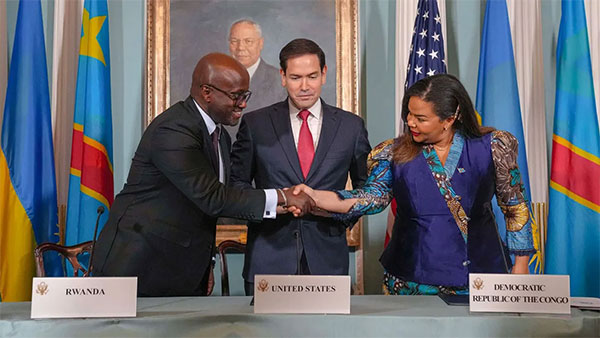
Seen in this light, American actions across the globe, from its steadfast support for Israel in its conflicts with Arab states and Iran, to its strategic engagements in Asia and Africa, are not isolated policies but pieces on a much larger geopolitical chessboard.
In these contests, the battlefield is often not defined by military strength alone, but by geography. Certain states become what strategists call geopolitical pivots.
A geopolitical pivot is a country whose importance does not derive from its military power but from its location. Such states sit astride trade routes, natural resource corridors, or strategic transit zones. As a result, whoever gains influence over them acquires the ability to project power far beyond their borders.
And this brings us, inevitably, to Africa.
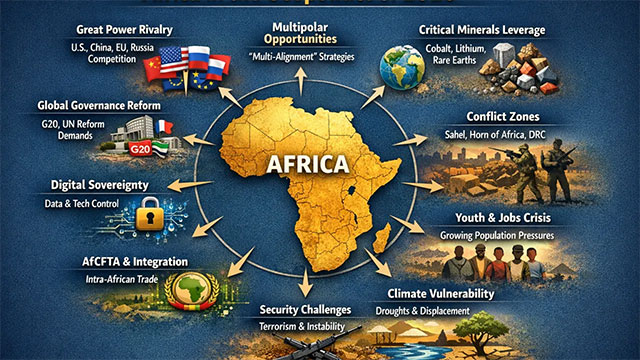
For Africa, the rise of multipolarity presents both profound risks and historic opportunities.
The opportunity lies first in strategic non-alignment. During the Cold War, many newly independent African states attempted to maintain neutrality between competing global blocs. A similar approach today could allow African nations to negotiate partnerships with multiple powers without becoming subordinate to any.
Second, Africa must recognise the reality of what many analysts now call the Second Scramble for Africa. China’s hunger for raw materials to sustain its industrial base, combined with Western efforts to reduce dependence on Chinese supply chains, has dramatically increased the strategic value of African minerals, energy resources, and agricultural land. For the first time in generations, this competition gives Africa bargaining power over the terms of extraction, infrastructure development, and industrial cooperation.
Third, Africa can exploit moments of Western disengagement. As donor fatigue grows in some regions, new actors, Asian, Middle Eastern, and Latin American, are entering African markets. If managed wisely, this diversification can shift partnerships away from dependency and toward mutually beneficial economic transformation.
But there is also danger.
Multipolar competition can easily turn parts of Africa into what strategists call exploitative zones, regions where external powers compete not to develop local societies but merely to secure resources and strategic advantage.
If African states fail to manage this competition, foreign rivalries will once again fuel instability, corruption, and proxy conflicts across the continent.
The antidote is not isolation, but strategic discipline.
African states must channel foreign competition into domestic development: building infrastructure, industrial capacity, and regional economic integration. Only by strengthening institutions and fostering regional powerhouses can Africa break the old cycle of dependency that has haunted it since the colonial era.
For if Africa merely becomes the chessboard upon which others play, the outcome will be familiar.
However, if Africa learns to play the game itself, then the age of multipolarity may yet mark the beginning, not of a second scramble, but of an African century.
And that, perhaps, is the real geopolitical contest of our time.
*****
By Andrew “Pi” Besi | On X: @BesiAndrew