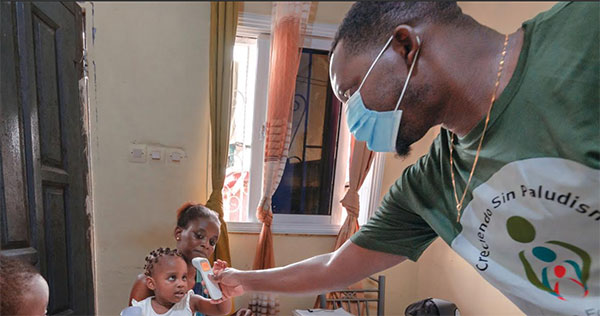
If the strategy succeeds, the small nation on the west coast of Central Africa, could become a test case for malaria elimination
NEWS ANALYSIS | RONALD MUSOKE | In the humid equatorial belt of Central Africa; where dense forests, heavy rains and winding rivers create ideal breeding grounds for mosquitoes, malaria has long been a stubborn public health adversary. For Equatorial Guinea, the disease has shaped health outcomes, economic prospects and daily life for decades.
Now the small oil-rich nation is attempting something few countries in malaria-endemic regions have managed: complete elimination.
Speaking during a virtual press briefing held on Feb. 26, hosted by the Addis Ababa-based Africa Centres for Disease Control and Prevention, Equatorial Guinea’s Minister of Health, Social Welfare and Health Infrastructure, Mitoha Ondo’o Ayekaba, laid out an ambitious national strategy known as Vision 2030.
The goal is simple but formidable—eradicate malaria across the country within the next five years. The plan builds on two decades of progress on Bioko Island and introduces a new phase of intervention combining vaccines, advanced surveillance, cutting-edge vector control and emerging technologies such as genetically modified mosquitoes.
“This is a historic transition from advanced malaria control to full national elimination,” Ayekaba said. But the path from control to eradication will test the limits of science, policy and community engagement.
From control to elimination
For more than two decades, the centrepiece of Equatorial Guinea’s malaria response has been the Bioko Island Malaria Control Project, focused on the island where the country’s capital Malabo is located. The results are said to have been dramatic. According to Ayekaba, the programme achieved a 75% reduction in malaria prevalence among children aged two to 14, while overall prevalence across all age groups fell to 7.2% in 2025, the lowest level ever recorded on the island.
The intervention combined indoor residual spraying, strengthened case management and high-resolution surveillance systems. These measures also drove a 78% reduction in malaria transmission intensity and an equally significant decline in child mortality.
“[The country achieved] a 78% reduction in all-cause mortality among children under five years old,” Ayekaba noted. He said other health indicators improved as well: Anaemia among pregnant women dropped by about 77%, and two major mosquito vector species were eliminated from the island.
Over 20 years, the government and its partners invested about US$130 million into the programme. Those gains established Bioko Island as one of the most advanced malaria-control platforms in Africa. But the minister acknowledged a key reality. “Control is not elimination,” he said, noting that malaria remains entrenched across much of Equatorial Guinea, a country with a population of 1.85 million.
The Vision 2030 roadmap
The new national strategy shifts the focus from reducing cases to interrupting transmission completely. For the 2026–2030 phase, the programme has secured US$116 million in financing. The government will contribute US$52 million, with international partners providing the remaining US$64 million.
“This balanced financing reflects both national ownership and sustained international confidence,” Ayekaba noted, adding that Vision 2030 rests on four strategic pillars.
Next-generation vaccines
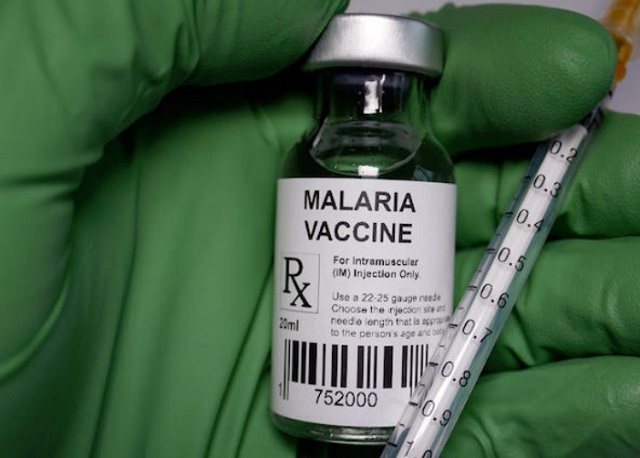
The first pillar (use of next-generation vaccines) involves deploying the R21/Matrix-M malaria vaccine, recently approved for use in several African countries. The vaccine will be integrated into routine immunisation schedules to strengthen protection among children—the demographic most vulnerable to malaria mortality. Combined with other interventions, officials hope vaccination can reduce the reservoir of infection in communities.
The second pillar expands vector control strategies beyond traditional measures. In addition to indoor residual spraying and insecticide-treated bed nets, Equatorial Guinea plans to deploy drone-based mosquito detection, strengthened entomological surveillance and potentially genetically modified mosquitoes designed to reduce malaria transmission.
The third pillar focuses on high-precision epidemiological monitoring capable of detecting small pockets of ongoing transmission. Authorities in Equatorial Guinea are aiming at identifying imported cases quickly, investigate them and trigger rapid response interventions.
The fourth pillar introduces a structured scientific oversight system through a technical advisory group composed of international experts, who will guide the country’s malaria elimination programme and ensure interventions are evidence-based and ethically implemented. “Together, these pillars represent a significant shift from conventional malaria control to a data-driven, technology-enabled elimination strategy,” Ayekaba said.
Why islands matter
A key component of the strategy involves targeting smaller, geographically isolated populations first. The government plans to begin with Annobón, a remote island province of Equatorial Guinea. The logic is epidemiological: islands offer natural barriers against re-introduction of disease. “We chose the island because it’s an island with a small human density,” Ayekaba explained.
Officials believe eliminating malaria among Annobón’s population—estimated at fewer than 1,500 residents—could happen within months if interventions are tightly coordinated. “If successful, we can eliminate malaria from this population in six months,” he said.
As for the rest of the country, the strategy also allows researchers to test surveillance mechanisms and border controls designed to prevent malaria reintroduction. It could provide insights into how human mobility affects disease transmission.
“That will also help us to learn in terms of mobility and reintroduction,” Ayekaba said, adding that lessons from Annobón will inform future interventions in larger and more complex environments such as Bioko Island and the mainland region of Río Muni.
The GM mosquito debate
Interestingly, among the most closely watched aspects of Equatorial Guinea’s strategy is its exploration of genetically modified mosquitoes as a vector control tool. The approach involves altering mosquito populations to reduce their ability to transmit malaria or to suppress their numbers entirely.
Ayekaba said the government is collaborating with researchers from the University of California to study the technology. “We are trying to follow all the research data, safety data and documentation of similar interventions in the past,” he said.
“We have set up an important international advisory group that will go along step by step with us to make sure that everything we do… is safe enough and ethical so that we do not compromise the safety and security of our people.”
Scientists generally see genetically modified mosquitoes as a promising but still evolving tool. While early trials have shown encouraging results, large-scale deployment remains rare and requires careful ecological monitoring and community consent. Uganda, too, is still carrying out trials using this tool to help elliminate elliminate malaria using GM mosquotoes.
Africa CDC’s perspective
The continental public health body, the Africa Centres for Disease Control and Prevention (Africa CDC), is playing a key role in supporting Equatorial Guinea’s elimination effort. The Director-General, Dr. Jean Kaseya, said during the briefing that the initiative demonstrates the importance of political commitment and multi-sector collaboration.
“The first one is the political will,” Kaseya said. He noted that the initiative is strongly backed by Equatorial Guinea’s president, Teodoro Obiang Nguema Mbasogo, who sees malaria elimination as essential for national development. “The second one is when you have the political will, you need also to bring partners together by showing leadership and putting money,” Dr. Kaseya added.
He said domestic funding commitments are particularly important for sustainability of such an initiative. “If the government doesn’t provide funding…it won’t be sustainable. Don’t dream to get money from partners,” he said.
Dr. Kaseya also highlighted the importance of multi-tool strategies combining vaccines, insecticide-treated nets, case management and indoor spraying. “In all continents where malaria was eliminated, you will see they did indoor spraying,” he said. “No one can come to tell us Africa cannot do the IRS.”
The surveillance backbone
Equally important within the plan is the creation of a regional public health laboratory to support molecular diagnostics and genomic surveillance. The facility will track malaria parasites and mosquito populations using advanced genomic techniques. These technologies will allow researchers to detect emerging threats such as drug resistance, insecticide resistance and diagnostic failures.
The laboratory will also support operational research and integrate Equatorial Guinea’s surveillance systems into continental networks coordinated by the Africa CDC. This data-driven approach is seen as crititical due to the fact that malaria elimination requires identifying and eliminating the last remaining chains of transmission.
Despite progress on Bioko Island, Equatorial Guinea continues tio grapple with malaria transmision. The country’s geography and climate make eradication particularly difficult. Located along the Gulf of Guinea, on Africa’s central-western coast, Equatorial Guinea experiences year-round malaria transmission due to its tropical climate.
Heavy rainfall creates abundant stagnant water where Anopheles mosquitoes, the primary malaria vectors, breed. In some mainland regions, parasite prevalence has reached 69%, classifying them as holoendemic areas with intense and stable transmission.
Low use of insecticide-treated bed nets in certain rural areas—sometimes below 40%—also contributes to continued transmission. Compounding the challenge is human mobility between the mainland and Bioko Island. Studies show that many remaining malaria cases on the islands are imported infections, carried by travelers from the mainland. This means that elimination requires not only reducing transmission locally but also preventing reintroduction.
Equatorial Guinea’s push to eliminate malaria comes as the continent continues to grapple with the deadly disease. Africa accounts for 95% of global malaria cases and 96% of malaria-related deaths, with children under five the most vulnerable.
But the momentum toward elimination is steadily growing. The World Health Organization has approved two malaria vaccines—RTS,S and R21/Matrix-M—which are now being deployed in several African countries. At the same time, genomic surveillance systems are expanding, and local manufacturing of diagnostics and vaccines is scaling up.
In 2024, both Cabo Verde and Egypt were certified malaria-free, joining a small but growing group of African countries that have eliminated the disease. Still, major threats remain, including drug resistance, insecticide resistance and climate change, which may expand mosquito habitats.
For Equatorial Guinea, eliminating malaria is about more than health. Ayekaba framed the initiative as an economic and social transformation. Malaria imposes significant costs on households through medical bills, lost productivity and missed school days, Ayekaba said. He believes that eliminating the disease could lift millions across Africa out of poverty.
“If we are able or capable of winning this battle in Equatorial Guinea,” he said, “there will be a huge hope for the rest of our brothers and sisters in the continent.”
The country’s leadership sees malaria as a structural barrier to development. “The president sees malaria as a poverty disease,” Ayekaba said. “If we win this battle, we will be able to further lift a lot of our population from poverty and be on the path of economic independence and health sovereignty.”
A high-stakes experiment
Equatorial Guinea’s Vision 2030 programme may become one of the most ambitious malaria elimination efforts in Central Africa. Its combination of vaccines, precision surveillance and experimental vector-control technologies could offer a blueprint for other countries struggling with persistent malaria transmission.
But success will depend on sustained financing, scientific oversight and community participation. As Dr. Kaseya emphasized, public understanding will be essential, particularly when introducing new technologies. “Populations that face a high burden of malaria… may see the potential benefits of this approach,” he said. “But it’s critical to have good communication.”
If the strategy succeeds, Equatorial Guinea could become a test case for malaria elimination in one of the world’s most difficult epidemiological landscapes. And if it fails, it will still offer valuable lessons for a continent that continues to bear the overwhelming burden of the disease. For now, the country is betting that science, political will and long-term investment can finally end malaria within its borders.